 Eric Sherman
A new wave of large FPSO developments is taking shape across multiple regions, as operators balance scale, cost discipline, emissions targets, and execution risk. This capital allocation strategy reflects what TechnipFMC chief executive Doug Pferdehirt describes as a profound "structural change" sweeping the oil and gas industry. According to Pferdehirt, the weight of global investment is moving decidedly away from US unconventionals (shale basins) and shifting toward these major offshore assets.
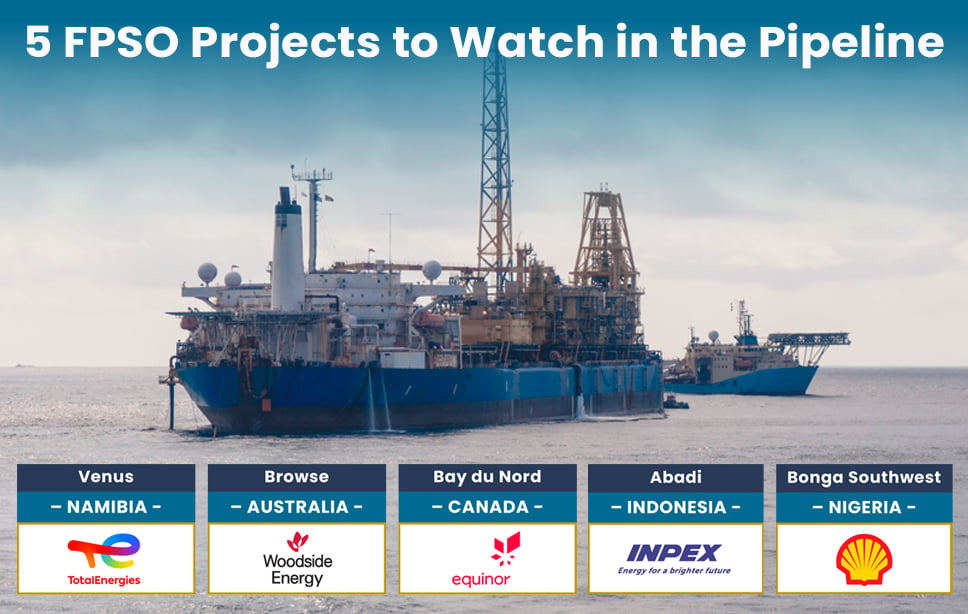
While timelines for these deepwater projects remain fluid, operators are prioritizing them over short-cycle shale in a strategic bid to successfully book long-term reserves and plan for the future. Consequently, the following five projects stand out for their size, strategic importance, and potential impact on a rapidly expanding FPSO market over the coming decade.
1. Venus - Namibia (TotalEnergies)
Venus is one of the most significant deepwater discoveries of the past decade. Since its 2022 discovery offshore Namibia, appraisal drilling and studies have confirmed an estimated ~2 billion barrels of recoverable resources, reinforcing its commercial potential.
TotalEnergies is progressing development based on a 150,000–160,000 bpd FPSO tied to up to 40 subsea wells in water depths of around 3,000 meters. Key development and environmental approvals have been submitted as the project advances toward sanction.
While the FID timeline has shifted to late 2026, Venus remains one of the largest upcoming FPSO opportunities globally and a cornerstone project for Namibia's emerging offshore oil sector. TotalEnergies continues to focus on cost competitiveness, emissions reduction, and efficient phased development, with first oil targeted around 2029–2030.
2. Browse - Australia (Woodside)
Browse remains one of the largest gas developments under consideration globally. Operated by Woodside, the project is based on two large offshore production facilities connected to the North West Shelf LNG infrastructure at Karratha, with carbon capture integrated into the development concept.
However, environmental approvals and emissions requirements continue to create uncertainty, keeping Browse in the category of longer-dated project opportunities despite ongoing engineering work.
If sanctioned, Browse would be a landmark contract for offshore contractors and a major source of long-term gas supply for the North West Shelf LNG project, reinforcing its strategic importance to Australia's energy sector.
3. Bay du Nord - Canada (Equinor)
Bay du Nord remains one of the most significant FPSO opportunities in the North Atlantic. Equinor has advanced the project into FEED, with ongoing work focused on refining costs, execution plans, and project economics ahead of a potential FID in 2027.
The project has faced delays in recent years as Equinor responded to inflation, supply chain pressures, and capital allocation priorities. However, recent agreements with government stakeholders and Equinor’s acquisition of BP’s stake have helped strengthen the development outlook.
If sanctioned, Bay du Nord would become Canada's first deepwater oil development, centered on a large FPSO with subsea tiebacks and an initial resource base of more than 400 million barrels. First oil is currently targeted for 2031.
4. Abadi - Indonesia (INPEX)
The Abadi LNG project is one of Asia’s largest undeveloped gas resources and a major long-term opportunity for the FPSO and LNG sectors. Operated by INPEX, the project entered FEED in 2025, with competitive engineering studies launched for both the FPSO and onshore LNG facilities as development momentum accelerates.
The development combines an FPSO, subsea infrastructure, an onshore LNG plant, and carbon capture and storage (CCS), targeting LNG production of approximately 9.5 mtpa.
While FID and first production remain several years away, Abadi has evolved from a delayed concept into a more clearly defined project following the entry of new partners, approval of a revised development plan, and commencement of FEED. Its scale, complexity, and strategic importance to Asian energy markets make it one of the most closely watched LNG developments in the region.
5. Bonga Southwest - Nigeria (Shell)
Shell’s renewed push to advance Bonga Southwest-Aparo (BSWA) has made it one of the most closely watched deepwater projects globally. The current concept emphasizes a simpler, more cost-competitive FPSO development aimed at improving project execution and investment returns.
Momentum has strengthened with new fiscal incentives and government support designed to unlock a final investment decision, which Shell is currently targeting for 2027. If sanctioned, BSWA would become Nigeria’s first deepwater project FID since 2008 and could attract up to $20 billion of investment, providing a major boost to the country's offshore sector.
Following years of redesign and unsuccessful tendering efforts, Bonga Southwest has been streamlined to improve affordability, execution certainty, and investment returns, positioning it as a potential catalyst for renewed deepwater investment in Nigeria.
Different Timelines, Shared Market Realities
Taken together, these five projects highlight how FPSO developments now span a wide range of timelines, from near‑term opportunities like Venus to longer‑cycle projects such as Browse and Abadi. They reflect a market where operators are moving at different speeds based on resource maturity, regulatory environments, capital discipline, and emissions requirements. FIDs are taking longer to reach, designs are being simplified or phased, and flexibility has become just as important as scale. While each project follows its own path, collectively they illustrate a new reality for the FPSO market—fewer developments moving quickly, greater scrutiny before sanction, and an increasing focus on resilience across price, cost, and energy‑transition scenarios.
How Can EMA Help
As FPSO projects move forward on increasingly varied timelines, staying informed requires more than headline tracking. EMA supports clients with clear visibility across the global FPSO pipeline—covering projects from early concept through FID, construction, production, and decommissioning. EMA monitors how projects are evolving over time, identify where momentum is building, and understand how changing market conditions are shaping development decisions. This insight enables commercial teams to prioritize opportunities, engage earlier with confidence, and align strategy with the realities of today’s offshore market.
📩 Get in touch:
eric.sherman@energymaritimeassociates.com