The next generation of floating projects will be shaped less by ambition and more by economics, execution timelines, and early-stage decisions.
That was the central takeaway from the first webinar, Floating energy, promise, peril and what comes after, in a three-part series hosted by Energy Maritime Associates (EMA) in partnership with Riviera Maritime Media, leading up to the Floating Energy Forum in London in May 2026.
Interest in floating wind, FPSOs, and FLNG remains high, but the market is clearly entering a more disciplined phase. Cost inflation, extended fabrication schedules, and contracting strategies set well before sanction are increasingly determining which projects advance and which stall.
Those realities framed the discussion throughout the opening session, where I was joined by panellists from NOV, and MODEC.
Floating Energy Market Conditions Today
We began by looking across offshore wind, floating production, and FLNG. In offshore wind, EMA’s forecast, excluding China, already assumes significant slippage and cancellation across planned projects. The trajectory is familiar and closely mirrors the early phase of FLNG development, when expectations ran ahead of execution capability.
As delays continue to mount, vessels and subsea assets are already shifting back from postponed wind projects into hydrocarbon work. The market is reasserting itself around fundamentals, and economics still matter most.
Floating Production
In floating production, we are seeing a structural shift toward gas-focused developments and very large FPSOs. While only four FPSOs were awarded in each of the past two years, capital costs per unit have climbed into the US$1 billion to US$4 billion range as projects grow in scale and complexity.
In EMA’s mid-case forecast, FPSO awards recover to roughly nine to 11 units per year, led by Brazil, followed by South America excluding Brazil, with African activity expected to recover later in the decade.
One of the most consistent risks we see is not geology or demand, but procurement. Contracting strategy set in the earliest stages often determines whether a project progresses at all. In several cases, flawed tender models have forced operators to restart procurement entirely, costing years of momentum.
Gas Markets
Gas markets reinforced similar themes. FLNG orders have reached all-time highs as long-deferred projects move to sanction, supported by post-Ukraine gas demand and rising power requirements tied to data centers.
Earlier FSRU oversupply, driven by speculative ordering and low-cost financing, has largely been absorbed by European demand. A key differentiator remains flexibility, as FLNG and FSRU units can often be redeployed more readily than bespoke FPSOs.
What the Audience Told Us
Live polling during the session reinforced these conclusions. A clear majority of respondents identified extended fabrication schedules pushing costs beyond sanction estimates as the single biggest risk to FPSO economics through 2030, while nearly two-thirds pointed to early conceptual design partnerships as the engagement model most likely to deliver optimal outcomes.
From Webinar to Forum: Continuing the Conversation
This session was the first step in a broader conversation that will continue through the webinar series and at the Floating Energy Forum on May 14, 2026.
The forum is designed to accelerate progress across floating energy technologies and project development. The webinar series is intended to build momentum by offering focused, data-driven insights into what is shaping project outcomes today and what will matter most over the next decade.
Across the webinar series and at the forum itself, we will continue exploring how floating hydrocarbon solutions can unlock stranded resources, deliver competitive economics, and support lower-impact developments in remote regions.
Watch the Full Webinar
To hear the full discussion, including detailed market analysis and audience Q&A, watch the webinar on demand and follow the series as we build toward the Floating Energy Forum.
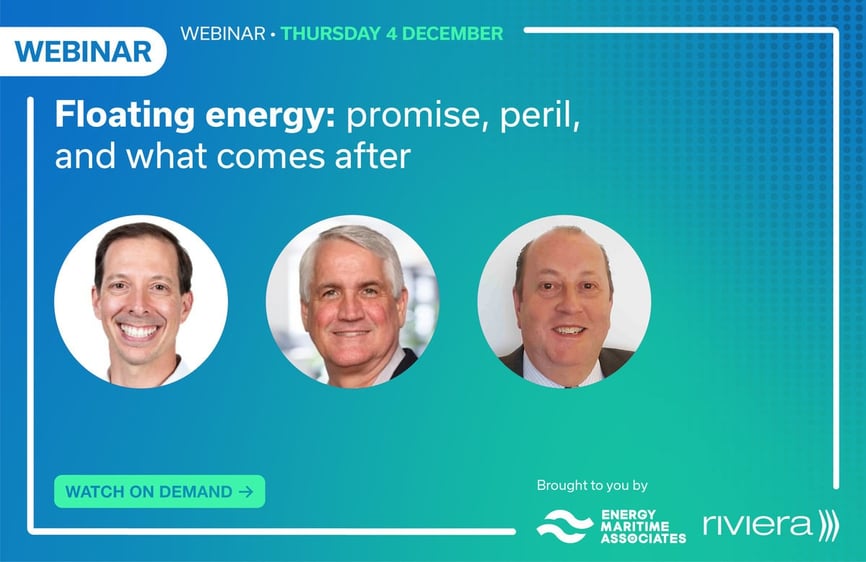
04 December 2025. From L-R: David Boggs (EMS), Cobie Loper (NOV), Boyd Howell (MODEC)
Moderator:
Edwin Lampert, Executive Editor and Head of Business Relations, Riviera Maritime Media
Panellists:
David Boggs, Director, Energy Maritime Associates
Cobie Loper, Senior VP, NOV
Boyd Howell, Director of Business Development, MODEC
For additional insights, read Riviera Maritime Media’s coverage of the webinar:
👉 Click here
Webinar Review:
Webinar registrations: 209
Duration: 01:07:39
Number of live questions: 56
The next webinar, “Successfully unlocking stranded gas using FLNGs and FSRUs”, will take place on Tuesday 24 February 2026 from 15:30 to 16:30 GMT, exploring market opportunities in East Africa and Guyana, financing dynamics, contracting realities and the trade-offs between leasing and ownership models.
For further information please contact:
David Boggs
Executive Director, EMA
email: david.boggs@energymaritimeassociates.com

 David Boggs

 David Boggs : Tue, Nov 11, 2025